Research
My work combines the analysis of variational formulations with their discretisation. These are the main lines, each with the articles that belong to it.
Poroelasticity and multiphysics coupling
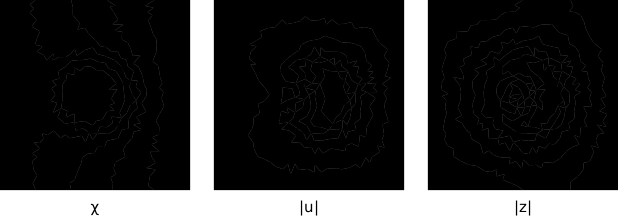
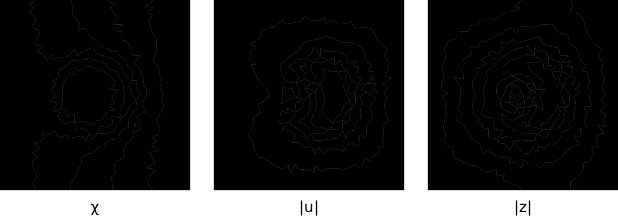
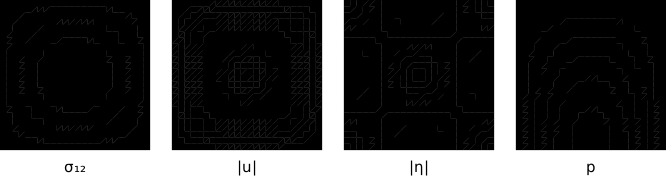
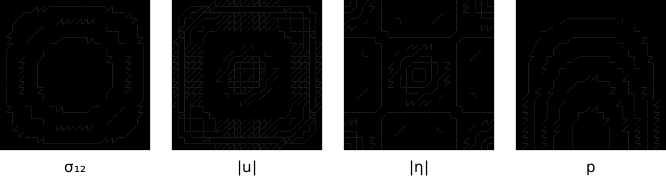
I study Biot's poroelasticity model and its couplings with heat transfer, Poisson–Nernst–Planck electrochemical transport, and Brinkman and Forchheimer flow. The formulations use the total pressure and pseudostress-type unknowns, and are designed to remain stable in the nearly incompressible limit, where standard discretisations suffer from locking. Applications include deformable porous media in engineering and fluid flow in biological tissues.
Related publications
-
2026
A five-field mixed formulation for the fully dynamic Biot–Brinkman model
ESAIM: Mathematical Modelling and Numerical Analysis, accepted
-
2026
A locking-free mixed-primal formulation for the Biot–Brinkman–Forchheimer model
Preprint 2026-9, GIANuC², Universidad Católica de la Santísima Concepción
-
2026
A pseudostress-based fully mixed finite element method for the stationary Biot–Poisson–Nernst–Planck system
Submitted
-
2026
A pseudostress-based fully mixed formulation for the unsteady Biot–Brinkman model
Preprint, GIANuC², Universidad Católica de la Santísima Concepción
-
2025
New Banach spaces-based mixed finite element methods for the coupled poroelasticity and heat equations
IMA Journal of Numerical Analysis, 45(4), 1936–1984
-
2025
Primal-mixed finite element methods for the coupled Biot and Poisson–Nernst–Planck equations
Computers & Mathematics with Applications, 186, 53–83
Flow in porous media and incompressible fluids
Mixed finite element methods for Stokes, Navier–Stokes, Brinkman and Brinkman–Forchheimer equations, including convective terms, variable porosity and nearly incompressible elasticity. The analysis relies on Banach-space formulations in which the natural integrability of the nonlinear terms determines the functional setting.
Related publications
-
2027
A priori and a posteriori error analysis of a mixed FEM for stationary convective Brinkman–Forchheimer flows with variable porosity
Journal of Computational and Applied Mathematics, 492, Article 118115
-
2026
A five-field mixed formulation for the fully dynamic Biot–Brinkman model
ESAIM: Mathematical Modelling and Numerical Analysis, accepted
-
2026
A locking-free mixed-primal formulation for the Biot–Brinkman–Forchheimer model
Preprint 2026-9, GIANuC², Universidad Católica de la Santísima Concepción
-
2026
A pseudostress-based fully mixed formulation for the unsteady Biot–Brinkman model
Preprint, GIANuC², Universidad Católica de la Santísima Concepción
-
2023
A Banach spaces-based fully-mixed finite element method for the stationary chemotaxis-Navier–Stokes problem
Computers & Mathematics with Applications, 145, 65–89
-
2022
A posteriori error analysis of Banach spaces-based fully-mixed finite element methods for Boussinesq-type models
Journal of Numerical Mathematics, 30, 325–356
-
2021
On the well-posedness of Banach spaces-based mixed formulations for the nearly incompressible Navier–Lamé and Stokes equations
Computers & Mathematics with Applications, 102, 87–94
-
2020
An augmented fully-mixed finite element method for a coupled flow-transport problem
Calcolo, 57
Transport, diffusion and their coupling with mechanics
Coupled problems in which a concentration or temperature is transported by a flow or driven by mechanical stress: stress-assisted diffusion, chemotaxis–Navier–Stokes, Boussinesq-type models, flow–transport systems and heat-assisted sedimentation. Well-posedness is typically obtained through fixed-point arguments combined with the theory of mixed and monotone problems.
Related publications
-
2026
Mixed finite element methods for a heat-assisted model of sedimentation
arXiv preprint arXiv:2610.28903
-
2026
A pseudostress-based fully mixed finite element method for the stationary Biot–Poisson–Nernst–Planck system
Submitted
-
2025
New Banach spaces-based mixed finite element methods for the coupled poroelasticity and heat equations
IMA Journal of Numerical Analysis, 45(4), 1936–1984
-
2025
Primal-mixed finite element methods for the coupled Biot and Poisson–Nernst–Planck equations
Computers & Mathematics with Applications, 186, 53–83
-
2023
New Banach spaces-based fully-mixed finite element methods for pseudostress-assisted diffusion problems
Applied Numerical Mathematics, 193, 148–178
-
2023
A Banach spaces-based fully-mixed finite element method for the stationary chemotaxis-Navier–Stokes problem
Computers & Mathematics with Applications, 145, 65–89
-
2022
A posteriori error analysis of Banach spaces-based fully-mixed finite element methods for Boussinesq-type models
Journal of Numerical Mathematics, 30, 325–356
-
2022
A pseudostress-based mixed-primal finite element method for stress-assisted diffusion problems in Banach spaces
Journal of Scientific Computing, 92
-
2020
An augmented fully-mixed finite element method for a coupled flow-transport problem
Calcolo, 57
A posteriori error analysis and adaptivity
Residual-based a posteriori error estimators for fully-mixed and mixed-primal methods, with proofs of reliability and efficiency, and their use to drive adaptive mesh refinement in problems with singularities or sharp layers.
Related publications
-
2027
A priori and a posteriori error analysis of a mixed FEM for stationary convective Brinkman–Forchheimer flows with variable porosity
Journal of Computational and Applied Mathematics, 492, Article 118115
-
2026
A pseudostress-based fully mixed finite element method for the stationary Biot–Poisson–Nernst–Planck system
Submitted
-
2022
A posteriori error analysis of Banach spaces-based fully-mixed finite element methods for Boussinesq-type models
Journal of Numerical Mathematics, 30, 325–356